How much gravel do I need for a driveway?
Measure the area you plan to cover, calculate its volume at the planned depth, then ask your supplier how that volume translates into an order.
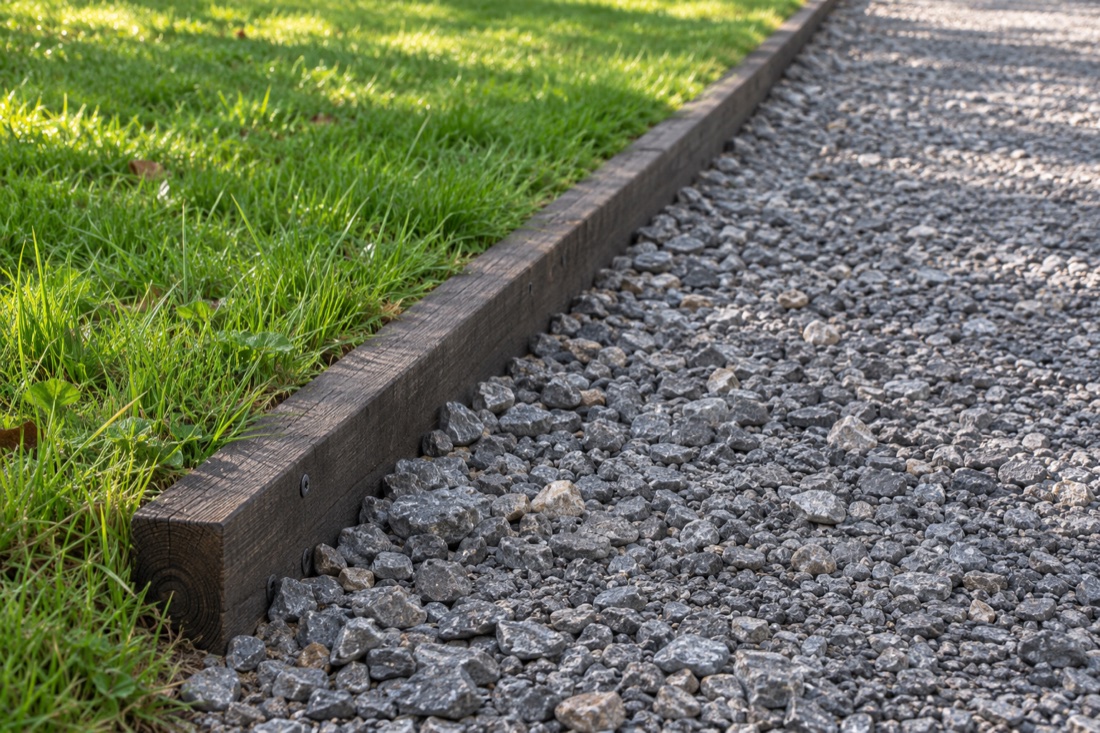
Measure each section
For a straight driveway, measure its length and width. For an L-shaped driveway, split it into two rectangles and count the corner in only one of them. Measure a wider parking bay or turnaround separately. Sketching the sections first makes it easier to spot overlaps.
Use the depth planned for the specific layer you are ordering. If your project has a base layer and a surface layer with different materials, estimate them separately. A resurfacing job and a new driveway may have different depth requirements. Confirm the layers and depth with your installer or supplier before ordering.
Convert your measurements to volume
US customary: length in feet × width in feet × depth in inches ÷ 324 = cubic yards.
Metric: length in metres × width in metres × depth in centimetres ÷ 100 = cubic metres.
A 40-foot by 10-foot rectangle at 3 inches deep is 100 cubic feet, or 3.70 cubic yards. An adjoining 10-foot by 8-foot bay at the same depth adds about 0.74 cubic yards. Together they need 4.44 cubic yards of placed volume. Add the unrounded volumes before rounding the total.
Gravel coverage by driveway size
| Driveway area | At 2 in | At 3 in | At 4 in |
|---|---|---|---|
| 200 ft² | 1.23 yd³ | 1.85 yd³ | 2.47 yd³ |
| 400 ft² | 2.47 yd³ | 3.70 yd³ | 4.94 yd³ |
| 600 ft² | 3.70 yd³ | 5.56 yd³ | 7.41 yd³ |
These are placed volumes before any supplier allowance or rounding. In metric, a 12 m × 3 m driveway at 7.5 cm deep needs 2.70 m³ placed. If the project uses different materials in the base and surface layers, use a separate calculation for each.
Ask how the supplier sells and delivers it
If the quote is by weight, ask for the density of the actual material and whether it applies to loose delivered material or the material placed on site. Ask how much extra to order for compaction or loss. A calculator can apply that allowance once you have it. Prices and densities depend on the product, and you may pay a billable minimum even for a smaller load.
Example only: at 1.35 US tons per cubic yard and zero allowance, the 3.70-cubic-yard rectangle comes to 5 US tons. At USD 38 per ton and USD 85 for delivery, the subtotal is USD 275 before tax. If that supplier charges for at least 6 tons, the same figures give USD 313. Confirm whether the minimum affects billing, delivery quantity, or both.
Before you order
- Confirm the material, density and order allowance with the supplier.
- Ask whether “ton” means a US short ton or a metric tonne.
- Check load rounding, delivery access, order minimums and tax.
See Bellhouse’s gravel estimating notes for an example of how a supplier distinguishes placed volume, delivered volume and truck loads.
Next, compare driveway gravel types and estimate the cost per ton and delivery charge.
Estimate your gravel order →